

Case Study No.3:
parking as paramount
Site planning for a commercial building project near Hobby Airport in Houston, TX began with the two primary pillars of gross floor area (GFA) yield: detention requirements & parking capacity.
During pre-development meetings with the City permitting office, it became clear that the site’s geometry—specifically the curved radius along the hypotenuse—created sight-line problems for oncoming traffic. As a result, access from the north street was not permissible. This constraint required that all vehicular access be established along the south frontage.
Driveway placement was then analyzed based on the total linear frontage along the right-of-way (ROW), factoring in minimum separation distances from both adjacent intersections. Because the third frontage functions only as a paper Right-Of-Way without actual access possible, these limitations effectively narrowed the site to a single viable driveway zone solution while still burdening the site with the added street ROW restrictions.
With the access point established, the parking layout was optimized to maximize site efficiency. A double-loaded drive aisle configuration was initially targeted to achieve the highest parking yield. However, the triangular geometry of the parcel dictated the ultimate layout. The drive aisle was aligned to follow the site’s predominant angular boundary, but this adaptation reduced double-loading efficiency, as the building pad location competed directly with parking on site.
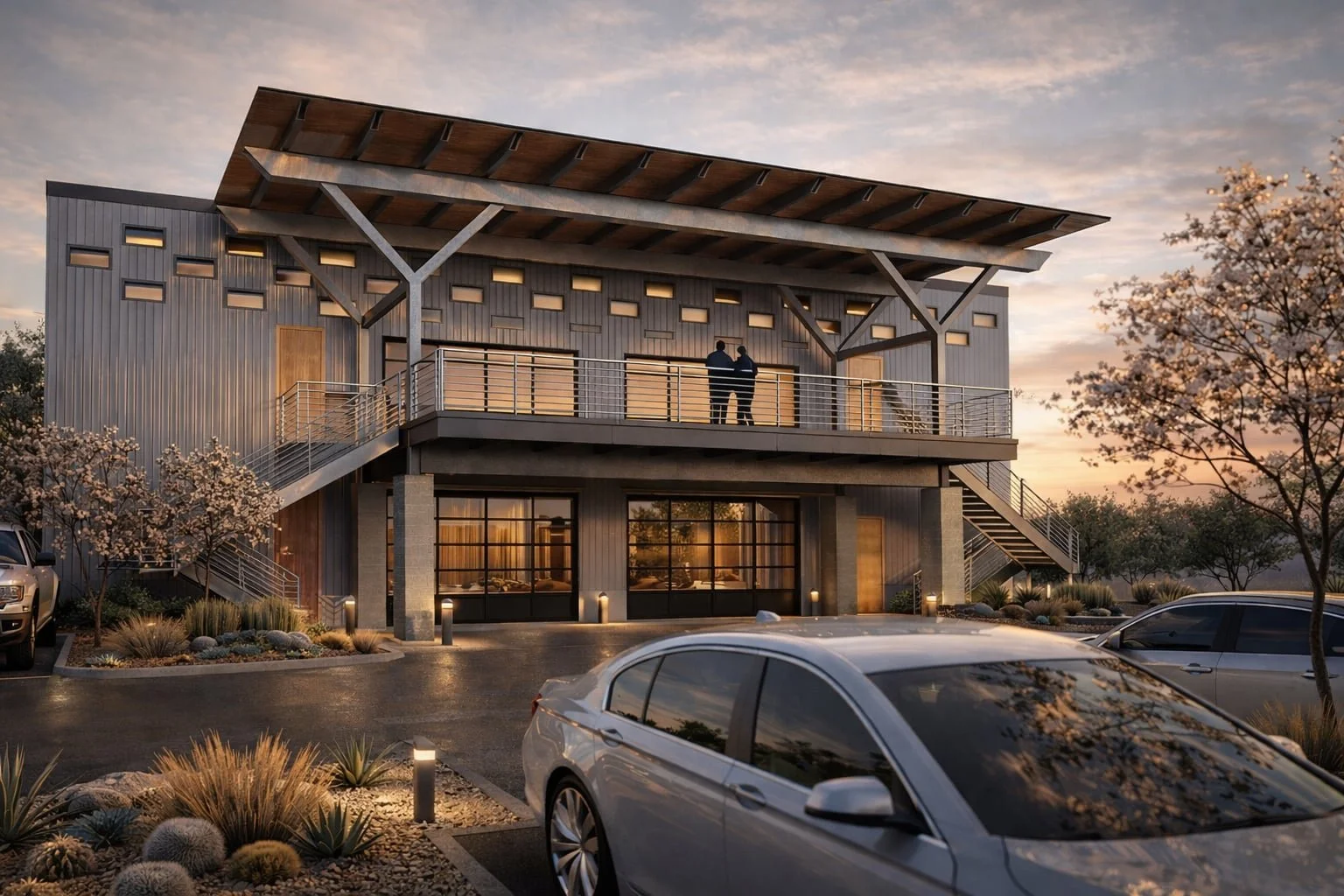
A digital rendering image of the building constructed in a 3D software utilizing Building Information Modeling (BIM).
An alternative strategy considered elevating the structure on a podium to introduce parking beneath. While this approach could increase on-site parking counts, it introduces a trade-off. For an office occupancy, higher parking ratios are required, ultimately reducing achievable GFA despite the added structured parking. By contrast, selecting a storage occupancy significantly lowers required parking ratios, allowing the project to remain viable within the constraints of surface parking capacity.
Given the operational requirements of a storage facility, the ground level must remain accessible at grade with overhead doors and appropriate vehicular maneuvering areas. These functional needs further informed the final site configuration, ensuring both regulatory compliance and operational practicality within a highly constrained triangular parcel.
An evaluation of required setbacks confirmed that a rectangular footprint of approximately 40' × 80' integrates effectively within the parking layout. However, a single-story building of roughly 3,200 square feet on a constrained site—particularly one requiring underground detention or a reinforced pond system—would not generate sufficient Gross-Floor-Area to support financial viability of the project.
From a construction standpoint, a 40' × 80' pre-engineered metal building (PEMB) is straightforward and cost-efficient. The challenge, therefore, was not structural feasibility but yield optimization. To improve project economics, the strategy shifted vertically.
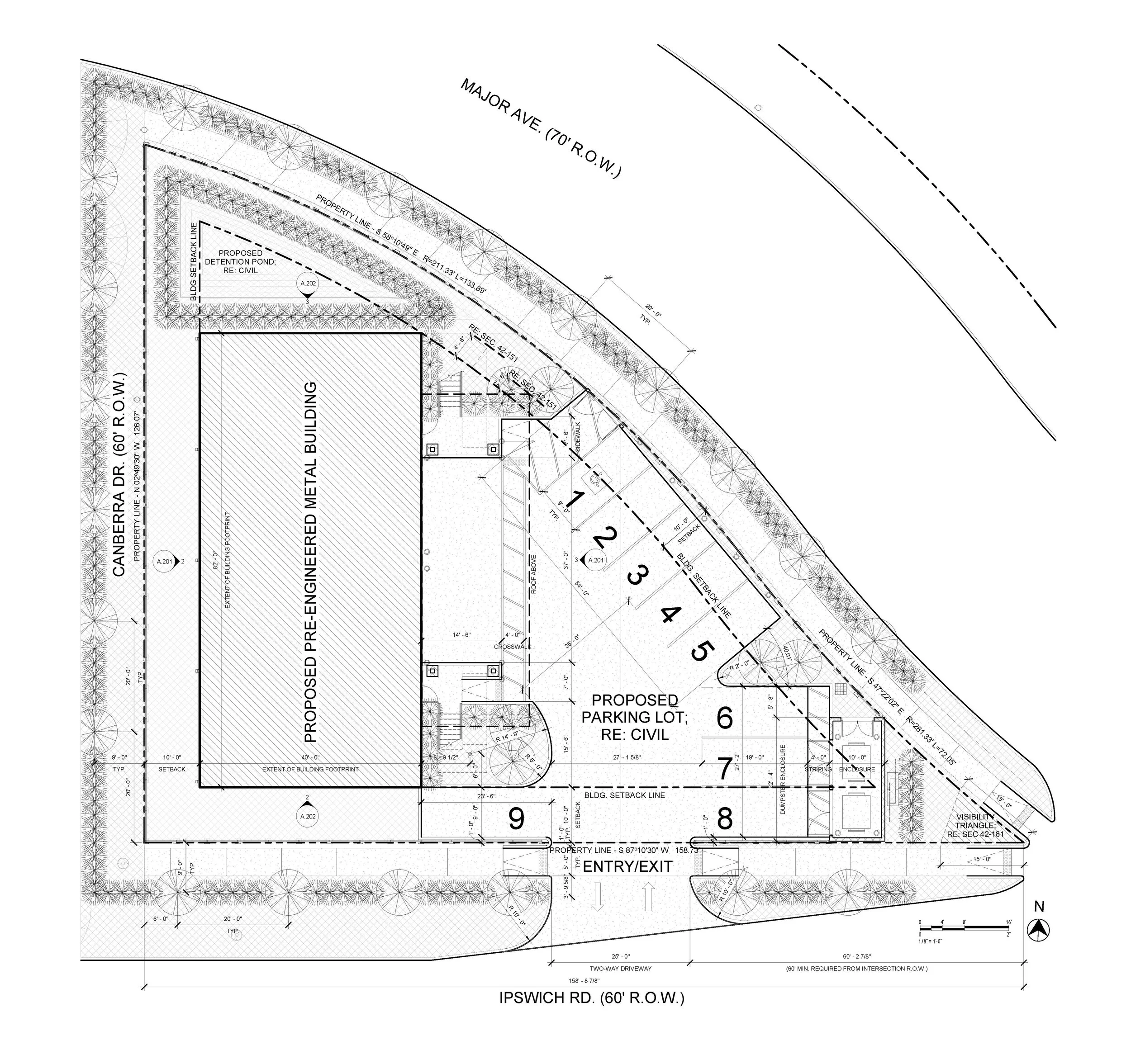
A site plan illustrates the entry/exit drive aisle & parking arrangement relative to building pad & detention pond.
While introducing a second or third story increases GFA, it also introduces code implications that can materially affect cost. To further enhance ROI without triggering more restrictive provisions—such as elevator requirements tied to accessibility standards—a mezzanine level was utilized. By definition, a mezzanine must not exceed one-third of the floor area below and must remain open to that level. Understanding this as architects allowed us to calculate maximum achievable GFA and model projected NOI early in the feasibility phase—well before detailed design documentation began.
This process illustrates how parking and site geometry, even more than detention itself, can became the primary driver of building citing and massing- and even project typology.
Detention was ultimately located in the residual site area as pictured. However, a conventional sloped-wall pond did not provide sufficient volume so the design incorporates vertical retaining walls to increase pond storage volume, supplemented by underground pipe storage and strategic grading within the parking lot to provide adequate storage volume.
While not the most economical solution for detention, this hybrid solution significantly reduced cost compared to all-underground detention, while making the most efficient use of limited site area available. The compromise was both necessary and justified, as it enabled a GFA yield sufficient to support the project’s financial performance objectives.

A physical 3D Study Model constructed from foam board was utilized to explore the effects of “going vertical” with building program to add valuable GFA.